Prostate Imaging Reporting and Data System (PI-RADS) and prostate cancer
Prostate Imaging Reporting and Data System (PI-RADS) assessment
Multiparametric magnetic resonance imaging (mpMRI) is an advanced imaging technique, often using a 3T scanner, that provides detailed, high-definition images of the prostate to detect and locate cancer
- by combining anatomical and functional imaging, it helps determine if a biopsy is necessary and assists in guiding biopsy needles to suspicious areas
- combines 3-4 different MRI sequences (including T1-weighted, T2-weighted, and Diffusion-Weighted Imaging) to show detailed structure, cell movement, and blood flow, providing more information than a standard MRI
PI-RADS version 2 (v2) uses a 5-point assessment scale indicating the likelihood that mpMRI findings correlate with the presence of clinically significant prostate cancer at a particular anatomic location:
- based on the current capabilities of mpMRI, clinically significant disease is defined as Gleason score >7 (including 3 + 4 with prominent but not predominant Gleason grade 4), and tumour volume >0.5 ml, and/or extraprostatic extension
- PI-RADS assessment categories derived from mpMRI examinations relate to likely histopathologic findings only and do not incorporate other patient or cancer characteristics, such as PSA or clinical cancer risk categories, and they do not directly inform the choice of treatments available if prostate cancer is diagnosed.
The PI-RADS v2 assessment categories are defined with the following scores:
- 1: Very low (clinically significant prostate cancer is highly unlikely to be present)
- 2: Low (clinically significant prostate cancer is unlikely to be present)
- 3: Intermediate (the presence of clinically prostate cancer disease is equivocal)
- 4: High (clinically significant prostate cancer is likely to be present)
- 5: Very high (clinically significant prostate canceris highly likely to be present)
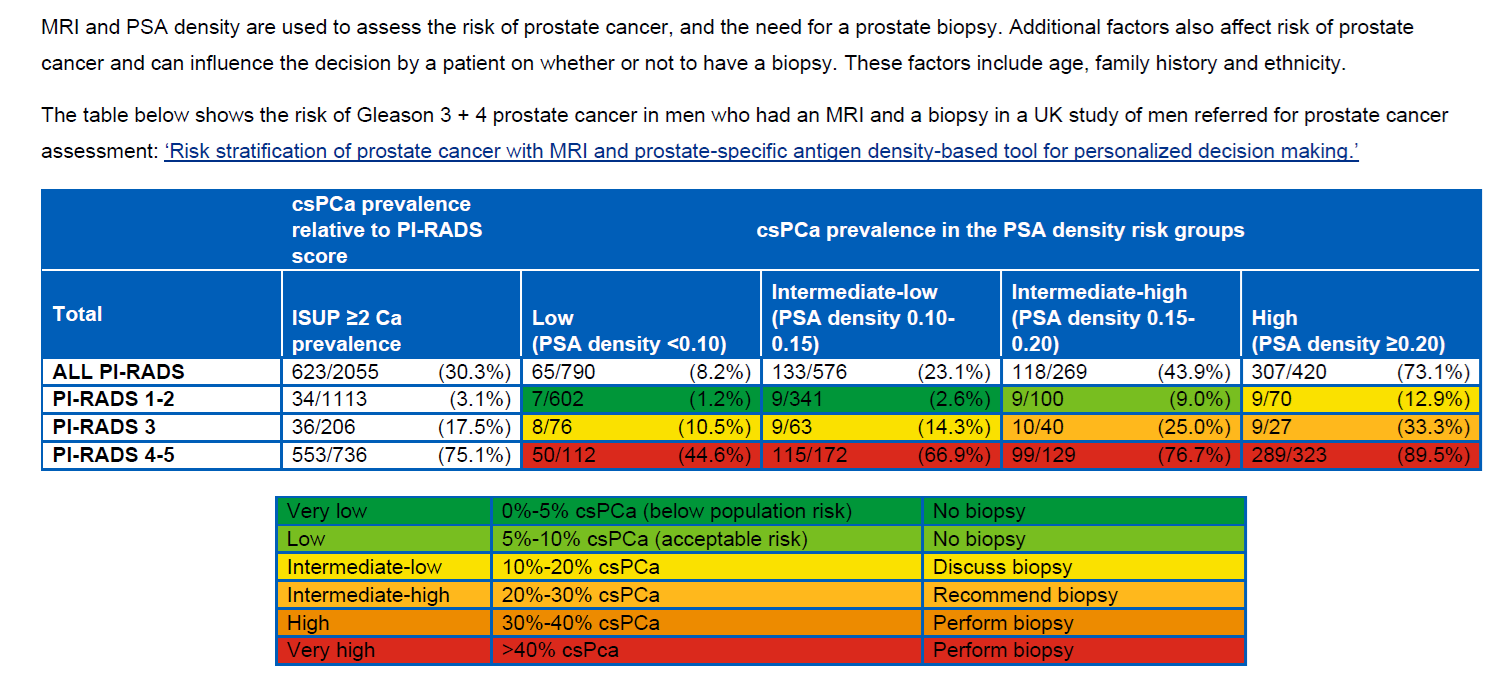
Where an MRI is equivocal, and a patient has a high PSA density or there are other strong clinical indicators of risk, for example family history particularly of prostate cancer death at an early age, patients should be offered a biopsy (3).
PSA density
The PSA density can be calculated from the current PSA and the prostate volume as measured on MRI (3)
- can be helpful as a secondary factor in deciding on biopsies in men with no MRI lesion
𝑃𝑆𝐴 𝑛𝑔/𝑚𝑙 / 𝑃𝑟𝑜𝑠𝑡𝑎𝑡𝑒 𝑣𝑜𝑙𝑢𝑚𝑒 𝑖𝑛 𝑚𝑙𝑠 = 𝑃𝑆𝐴 𝑑𝑒𝑛𝑠𝑖𝑡𝑦
Use of PSA density at different MRI scores (3)
Reference:
- Barentsz JO et al. Synopsis of the PI-RADS v2 Guidelines for Multiparametric Prostate Magnetic Resonance Imaging and Recommendations for Use. Eur Urol. 2016 Jan;69(1):41-9.
- Spektor M, Mathur M, Weinreb JC. Standards for MRI reporting-the evolution to PI-RADS v 2.0. Transl Androl Urol. 2017 Jun;6(3):355-367.
- Getting It Right First Time (GIRFT). Towards better diagnosis & management of suspected prostate cancer [Internet]. London: NHS England; 2024 Apr
Related pages
Create an account to add page annotations
Annotations allow you to add information to this page that would be handy to have on hand during a consultation. E.g. a website or number. This information will always show when you visit this page.