Short-lasting unilateral neuralgiform headache attacks with conjunctival injection and tearing (SUNCT) syndrome
Short-lasting Unilateral Neuralgiform headache attacks with Conjunctival injection and Tearing (SUNCT) syndrome (1,2,3):
- is considered a rare condition characterised by moderate or severe neuralgiform pain typically located in the area of the first division of the trigeminal nerve – but can be felt anywhere in the head
- attack episodes are very short (5 to 250 seconds) and can be described as single stabs, series of stabs or in a sawtooth pattern
- male-to-female ratio of 1.5:1 (2)
- a mean age of onset around 50 years
- rare with an annual incidence of 1.2 per 100,000 (2)
- proposed mechanisms involve trigeminal–autonomic reflex activation and hypothalamic dysfunction, although the exact aetiology remains unclear
- secondary causes, such as posterior fossa lesions, pituitary pathology, and vascular compression, must be excluded
Clinical features:
- attacks are strictly unilateral, generally with the pain persistently confined to the ocular/periocular area
- most attacks are moderate to severe in intensity and burning, stabbing or electrical in character
- mean duration of paroxysms is 1 minute, with a usual range of 10 to 120 seconds (total range 5 to 250 seconds)
- a diagnosis of SUNCT requires at least 20 episodes, with a minimum of 1 daily attack (2)
- prominent, ipsilateral conjunctival injection and lacrimation regularly accompany the attacks
- nasal stuffiness/rhinorrhoea are frequently noted
- during attacks, there is increased intraocular pressure on the symptomatic side and swelling of the eyelids
- no changes in pupil diameter have been observed (3)
Comparison of SUNCT with cluster headaches:
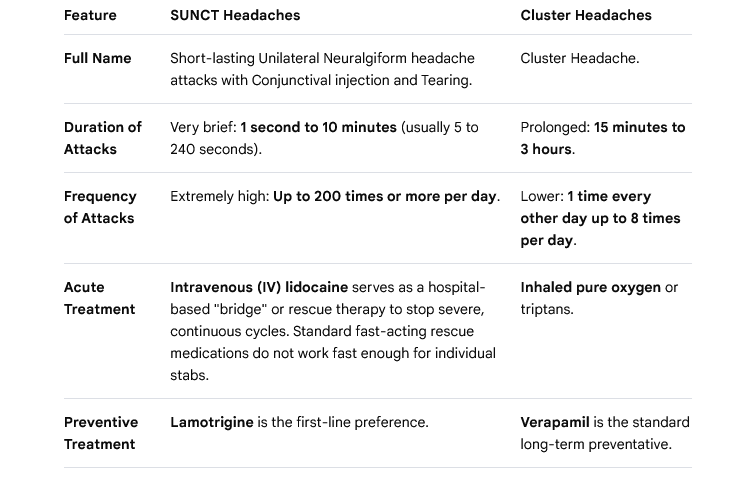
Management:
- seek expert advice
- intravenous lidocaine has demonstrated partial symptom relief in patients with SUNCT (2)
- long-term therapy
- lamotrigine is the first-line therapy, with up to 80% of patients reporting symptomatic improvement (2)
- alternative options include carbamazepine, oxcarbazepine and lamotrigine
Notes:
- short-lasting unilateral neuralgiform headache (SUNHA) is a rare primary headache disorder within the trigeminal autonomic cephalalgias, characterised by very frequent, brief attacks of moderate-to-severe unilateral orbital or temporal pain lasting seconds to minutes
- two phenotypes include
- short-lasting unilateral neuralgiform headache with conjunctival injection and tearing (SUNCT) and
- short-lasting unilateral neuralgiform headache with cranial autonomic symptoms (SUNA)
- two phenotypes include
References:
- Gay-Escoda C et al. Sunct syndrome. Report of a case and treatment update. J Clin Exp Dent. 2015 Apr 1;7(2):e342-7.
- Al Khalili Y, Patel J, Veerapaneni KD. Short-Lasting Unilateral Neuralgiform Headache. [Updated 2026 Mar 29]. In: StatPearls [Internet]. Treasure Island (FL): StatPearls Publishing; 2026 Jan-.
- Pareja JA, Caminero AB, Sjaastad O. SUNCT Syndrome: diagnosis and treatment. CNS Drugs. 2002;16(6):373-83.
Create an account to add page annotations
Add information to this page that would be handy to have on hand during a consultation, such as a web address or phone number. This information will always be displayed when you visit this page