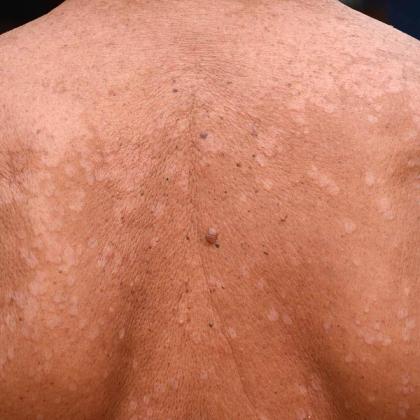
Pityriasis versicolor is a fungal condition caused by overgrowth of Malassezia – a yeast that is commonly found on the skin in most people. In this episode, Dr Kate Chesterman discusses the clinical findings that become visible when there is overgrowth of this yeast and explores the treatment options available to manage initial and recurrent episodes.
Key take-home points
- Pityriasis versicolor is a common fungal infection of the skin caused by yeast from the Malassezia species.
- Malassezia is part of the normal skin flora in 90–100% of people, but in certain conditions, overgrowth of the pathological form can occur.
- The condition presents with discrete oval macules or confluent patches that have a fine scale. They may be a pale, coppery brown, dark brown, pink or paler than the surrounding skin.
- On lighter skin, the affected areas are often hyperpigmented, whereas on darker skin, the areas are more likely to be hypopigmented. In lighter skin, the patches may become more obvious in the sun if they fail to tan.
- The areas are usually asymptomatic, but there may be a mild itch.
- The most affected areas include the upper trunk, upper arms, neck and abdomen. It can also affect the axillae, head, groin, thighs, genitalia, backs of the hands and the popliteal fossa.
- Diagnosis is usually clinical, but can be confirmed with skin scraping if there is doubt.
- Initial treatment is usually with an antifungal cream such as clotrimazole, ketoconazole or terbinafine applied twice daily for 2–3 weeks or with ketoconazole shampoo that should be lathered and applied to the affected skin for 10 minutes before rinsing off, repeated daily for up to 5 days.
- Ketoconazole shampoo is not licensed for use in those under the age of 12 and is not recommended in pregnancy.
- Mycological cure is usually achieved soon after treatment, but pigment changes usually take several weeks to resolve and can persist for months or years in some cases.
- If there is evidence of ongoing infection after treatment (persisting scale, erythema, itch or positive mycology), check whether the treatment was used correctly and whether there could be an alternative diagnosis. Skin scrapings could be taken if not already done.
- Consider offering an oral treatment such as itraconazole 200 mg once daily for 7 days or fluconazole 50 mg daily for 2–4 weeks.
- Recurrence is common; recurrence can be treated in the same way as the initial episode.
- In cases of frequent recurrence, consider advising prophylactic treatment with ketoconazole shampoo applied every 1–4 weeks for 6 months to try to reduce the risk of future episodes.
- Refer to dermatology if:
- The diagnosis is uncertain, or if the patient is not responding to treatment in primary care
- There is severe or extensive disease
- Consideration is being given to long-term, oral anti-fungal medication
- Children or pregnant women are affected
- The affected person has immunodeficiency or immunosuppression.
Key references
- Primary Care Dermatology Society. 2023. https://www.pcds.org.uk/clinical-guidance/pityriasis-versicolor.
- Dermnet. 2021. https://dermnetnz.org/topics/pityriasis-versicolor.
- Renati S, et al. BMJ 2015;350:h1394. doi: 10.1136/bmj.h1394.
- Primary Care Dermatology Society. 2025. https://www.pcds.org.uk/patient-info-leaflets/pityriasis-versicolor.
- British Association of Dermatologists. 2023. https://www.bad.org.uk/pils/pityriasis-versicolor.
Create an account to add page annotations
Add information to this page that would be handy to have on hand during a consultation, such as a web address or phone number. This information will always be displayed when you visit this page