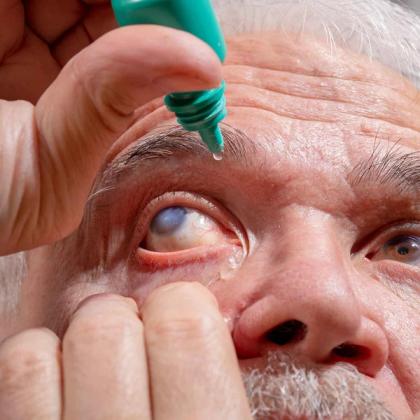
Glaucomas are a leading cause of irreversible vision loss worldwide. They encompass a range of disorders, including primary open-angle, angle-closure, normal-tension and secondary glaucomas, each with distinct pathophysiology, risk factors and clinical presentations. In this episode, Dr Roger Henderson looks at how elevated intraocular pressure (IOP) drives optic nerve damage and also examines cases where pressure remains normal. He considers diagnostic strategies, including tonometry and visual field testing, and emphasises the importance of early detection. Finally, he covers glaucoma management, from pharmacologic therapy and laser procedures to surgical interventions and minimally invasive options, highlighting individualised approaches for each subtype.
Key take-home points
- Glaucoma is a progressive optic neuropathy that leads to irreversible vision loss if untreated.
- Elevated IOP is the primary modifiable risk factor for glaucoma, but not all glaucoma occurs with high pressure, highlighting the role of vascular and individual susceptibility factors.
- Primary open-angle glaucoma is often asymptomatic until significant optic nerve damage has occurred, which is why routine screening is so critical.
- Normal-tension glaucoma can cause optic nerve damage despite pressures consistently below 21 mmHg. It often involves vascular dysregulation, nocturnal hypotension or increased optic nerve sensitivity.
- Angle-closure glaucoma can present acutely and constitutes an ophthalmic emergency requiring rapid intervention to prevent permanent vision loss.
- Secondary glaucomas arise from conditions like trauma, neovascularisation, pseudoexfoliation, pigment dispersion, steroid use or prior surgery, and management must address the underlying cause.
- Diagnosis relies on a combination of history and investigations such as tonometry and visual field testing to fully evaluate the patient’s risk and disease status.
- Early detection is critical because optic nerve damage is irreversible, making routine eye examinations essential for at-risk populations.
- Medical therapy for glaucoma includes prostaglandin analogues, beta-blockers, alpha-2 agonists, carbonic anhydrase inhibitors and occasionally miotics, each with unique mechanisms and side-effect profiles.
- Laser therapy, such as trabeculoplasty or peripheral iridotomy, is used to enhance aqueous outflow or relieve pupillary block, offering an important adjunct or alternative to medications.
- Surgical options, including trabeculectomy, tube shunts and minimally invasive glaucoma surgeries, are indicated when medical and laser therapy are insufficient to control IOP.
- Management must be individualised, taking into account glaucoma subtype, disease severity, comorbidities, patient adherence and lifestyle factors.
- In normal-tension glaucoma, lowering IOP and addressing systemic contributors like nocturnal hypotension or vascular disease can slow progression and preserve visual function.
- Secondary glaucoma requires treating the underlying cause in addition to lowering IOP to prevent ongoing optic nerve damage.
- Ongoing monitoring and patient education are essential to maintain long-term vision and detect progression early.
Key references
- NICE. 2022. https://www.nice.org.uk/guidance/ng81.
- International Council of Ophthalmology. https://icoph.org/eye-care-delivery/glaucoma/.
- Weinreb, RN, et al. 2016:2:16067. doi: 10.1038/nrdp.2016.67.
- American Academy of Ophthalmology. 2020. https://www.aao.org/education/preferred-practice-pattern/primary-angle-closure-disease-ppp.
Create an account to add page annotations
Add information to this page that would be handy to have on hand during a consultation, such as a web address or phone number. This information will always be displayed when you visit this page