Human immunodeficiency virus
The human immunodeficiency virus (HIV) is considered to be one of the most devastating infectious diseases to have emerged in the recent history.
- it is a chronic condition characterized by progressive immunodeficiency, a long clinical latency period and opportunistic infections (1)
- HIV is the cause of the acquired immune deficiency syndrome (AIDS)
HIV is a member of the lentivirus genus of the Orthoretrovirinae subfamily of the Retroviridae family of viruses (2)
- various different primates are naturally infected with more than 40 different lentiviruses, termed simian immunodeficiency viruses (SIVs)
- these viruses are largely nonpathogenic in their natural hosts
- cross-species transmissions of these SIVs from different primates resulted in the emergence of HIV (3)
HIV targets primarily CD4 positive cells (CD4+) and replicates rapidly within these cells throughout all stages of the infection
- normally a healthy human has a CD4+ count of 800 to 1200 cells per mm3 of blood
- HIV causes qualitative defects in function and progressive destruction of CD4 cell count which results in an immunological decline
- initially replacement of CD4 cells matches the rate of destruction, but in AIDS the gap between destruction and replacement widens and immunological failure occurs
- usually it takes a number of years for CD4 counts to reduce to levels which will compromise the immune system
- once the CD4+ count drops below 500 cells/mm3, minor infections including cold sores (herpes simplex), condyloma (warts) and fungal infections, thrush and vaginal candidiasis, may occur
- as the CD4+ count drops below 200 cells/mm3, patient becomes susceptible to the serious opportunistic infections and cancers characteristic of end stage HIV infection
- many of the characteristic consequences of AIDS are due to immunological failure (4,5).
An individual is said to have a HIV infection when he /she is recognized with HIV infection regardless of the clinical stage (which includes severe or stage 4 clinical disease also known as AIDS) and confirmed by laboratory criteria according to country definitions and requirements (3).
There are two distinct types of HIV:
- type 1 (HIV-1) - causes the majority of infections throughout the world
- type 2 (HIV-2) - seen mostly in West Africa, although individual cases have been reported in other parts of Africa, Europe, the Americas and Asia (India) (6)
The UK Health Security Agency (UKHSA) has published the first provisional HIV data on new diagnoses, to provide more timely overview of preliminary emerging trends & inform delivery of HIV Action Plan for England 2025 to 2030 (7):
- data indicates new HIV diagnoses fell in England from 2,922 in 2024 to 2,542 in 2025
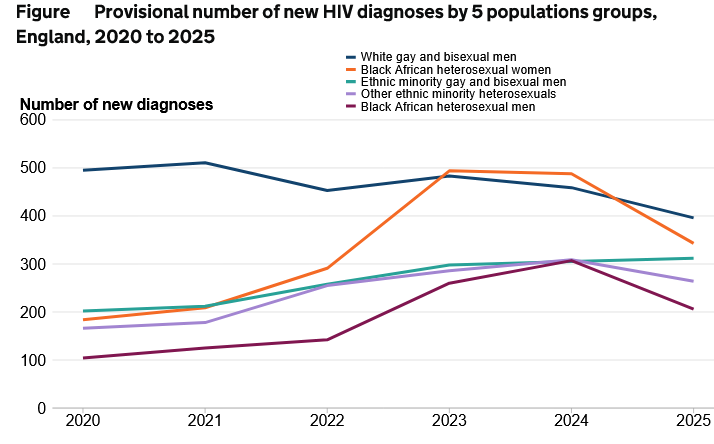
The graphic shows the provisional number of HIV diagnoses for the 5 population groups identified in the HIV Action plan (7):
- a 14% decrease from 459 in 2024 to 396 in 2025 was observed in White gay and bisexual men
- however, the number of diagnoses rose by 2% from 305 in 2024 to 312 in 2025 among ethnic minority gay and bisexual men
- the number of HIV diagnoses fell between 2024 and 2025 by 33% from 307 to 206 among Black African heterosexual men and by 30% from 488 to 343 among Black African heterosexual women
- was a 15% decrease from 309 to 264 HIV diagnoses among Other ethnic minority heterosexuals (excluding Black Africans)
Reference:
- Sax Paul E, Cohen Calvin J, Kuritzkes Daniel R. HIV Essentials 2017. Jones & Bartlett Learning, 2017
- World Health Organization (WHO) 2007. WHO case definitions of HIV for surveillance and revised clinical staging and immunological classification of HIV-related disease in adults and children
- Sharp PM, Hahn BH. Origins of HIV and the AIDS Pandemic. Cold Spring Harbor Perspectives in Medicine: 2011;1(1):a006841
- The Medical Foundation for AIDS & Sexual Health (MedFASH) 2016. HIV in primary care: an essential guide to HIV for GPs, practice nurses and other members of the primary healthcare team
- Klimas N, Koneru AO, Fletcher MA. Psychosom Med. Overview of HIV. 2008;70(5):523-30
- Wilson E, Tanzosh T, Maldarelli F. HIV diagnosis and testing: what every healthcare professional can do (and why they should). Oral Dis. 2013;19(5):431-9.
- New HIV diagnoses data in England 2020 to 2025: provisional data. May 2026, UK Health Security Agency, London.
Related pages
- Different subtypes of HIV
- Epidemiology
- Genetics of HIV
- Structure of HIV
- Natural history and prognosis of HIV infection
- Differential diagnosis of acute HIV infection
- Considering a possible diagnosis of HIV when in primary care
- Laboratory tests for HIV infection
- Treatment of HIV/AIDS
- Recommended groups for routine HIV tests
- Prognosis in HIV
- Acquired immune deficiency syndrome
- HIV (congenital)
- Case definition of HIV infection
- Pattern of infection in HIV and different CD4 counts
- Clinical indicator conditions associated with untreated HIV infections and recommendations for HIV testing
- Summary of vaccination recommendations for HIV infected individuals
- Safer sex advice
Create an account to add page annotations
Add information to this page that would be handy to have on hand during a consultation, such as a web address or phone number. This information will always be displayed when you visit this page